
Growing a business is more challenging than ever, especially when you have limited time and resources. That is where AI Marketing Tools make a real difference. Powered by Artificial intelligence, these solutions help automate repetitive tasks, improve Digital marketing efforts, and boost overall Business productivity without increasing costs.
Whether you need help with creating content, managing social media, or analyzing customer data, the right AI marketing software can simplify your daily work. In this guide, you will discover the Best AI Marketing Tools for Small Business, learn how they work, compare their features, and find the perfect solution to increase efficiency, attract more customers, and grow your business confidently in 2026.
What Are AI Marketing Tools for Small Businesses?
Running a small business often means wearing many hats. You may handle marketing in the morning, answer customer emails in the afternoon, and manage finances before the day ends. As your business grows, these responsibilities become harder to manage. This is where AI Marketing Tools can make a significant difference. Instead of spending hours on repetitive tasks, you can use Artificial intelligence to complete work faster, improve accuracy, and focus on growing your business.
Simply put, AI marketing tools are AI-powered software applications that use machine learning and automation to perform marketing tasks with minimal human effort. These tools analyses data, recognize patterns, and provide recommendations that help businesses make smarter decisions. Whether you want to write blog posts, schedule social media updates, optimize your website, or improve customer communication, AI simplifies the entire process.
Unlike traditional software, AI continues learning from data and user behavior. This means the recommendations become more accurate over time. For example, an email marketing platform can study how customers interact with your campaigns and suggest the best time to send future emails. Similarly, an SEO tool can analyses competitors and recommend improvements that help your website rank higher on Google.
Small businesses especially benefit because they often have limited budgets and fewer employees. Hiring a content writer, graphic designer, SEO expert, and social media manager can be expensive. Instead, AI helps one person perform the work of several specialists. While AI should never replace human creativity, it can eliminate repetitive work and improve Business productivity every day.

Today, businesses use AI for almost every area of Digital marketing. Blog writing, product descriptions, keyword research, customer support, social media management, advertising, and analytics can all be improved through intelligent automation. Many platforms also include an AI assistant that provides suggestions and completes tasks based on simple instructions.
For example, imagine you own a local bakery in Texas. Every week, you need Facebook posts, Instagram images, promotional emails, and a blog article about seasonal recipes. Instead of spending an entire weekend creating content, AI tools can generate ideas, design graphics, write captions, and even recommend the best publishing schedule. You review the output, make small edits, and publish everything within a fraction of the usual time.
Another important advantage is consistency. Customers expect businesses to remain active online. AI helps you maintain regular communication without feeling overwhelmed. Instead of missing social media updates or delaying newsletters, you can automate large parts of your marketing while keeping your brand voice consistent.
The following table shows how different AI Marketing Tools support everyday business activities.
| Business Task | Traditional Method | AI-Powered Solution |
| Blog Writing | Write every article manually | AI content editor creates high-quality drafts |
| Social Media | Create every post individually | AI for social media generates multiple posts instantly |
| Email Campaigns | Manual writing and scheduling | AI email assistant automates personalized emails |
| SEO | Manual keyword research | SEO optimization with AI recommendations |
| Customer Support | Staff answer every enquiry | AI chatbot and Live chat provide instant responses |
| Reporting | Manual spreadsheets | Business analytics dashboards update automatically |
The popularity of AI continues to increase because it saves time without reducing quality. Instead of replacing business owners, AI works alongside them as a reliable digital assistant. When used correctly, it helps small businesses compete with much larger companies while keeping costs under control.
Benefits of Using AI Marketing Tools for Small Businesses
Every business owner wants better results with less effort. That is exactly why AI Marketing Tools have become an essential part of modern business. They automate repetitive tasks, improve customer experiences, and help businesses make smarter decisions based on data rather than guesswork.
One of the biggest benefits is faster Content creation. Writing blogs, social media posts, email newsletters, and product descriptions often consumes several hours every week. AI speeds up this process by generating quality first drafts in minutes. You still review and personalize the content, but the time savings are substantial.
Another major advantage is Marketing automation. Instead of manually sending emails or scheduling social media posts every day, AI can perform these tasks automatically. Businesses create campaigns once, and the software delivers messages at the right time based on customer behavior. This improves consistency while reducing manual work.
Customer communication also becomes more efficient. Modern Customer relationship management systems combine CRM, Lead scoring, and Pipeline management to help businesses identify their most valuable prospects. Rather than contacting every lead equally, AI highlights customers who are most likely to buy, allowing sales teams to focus their efforts where they matter most.
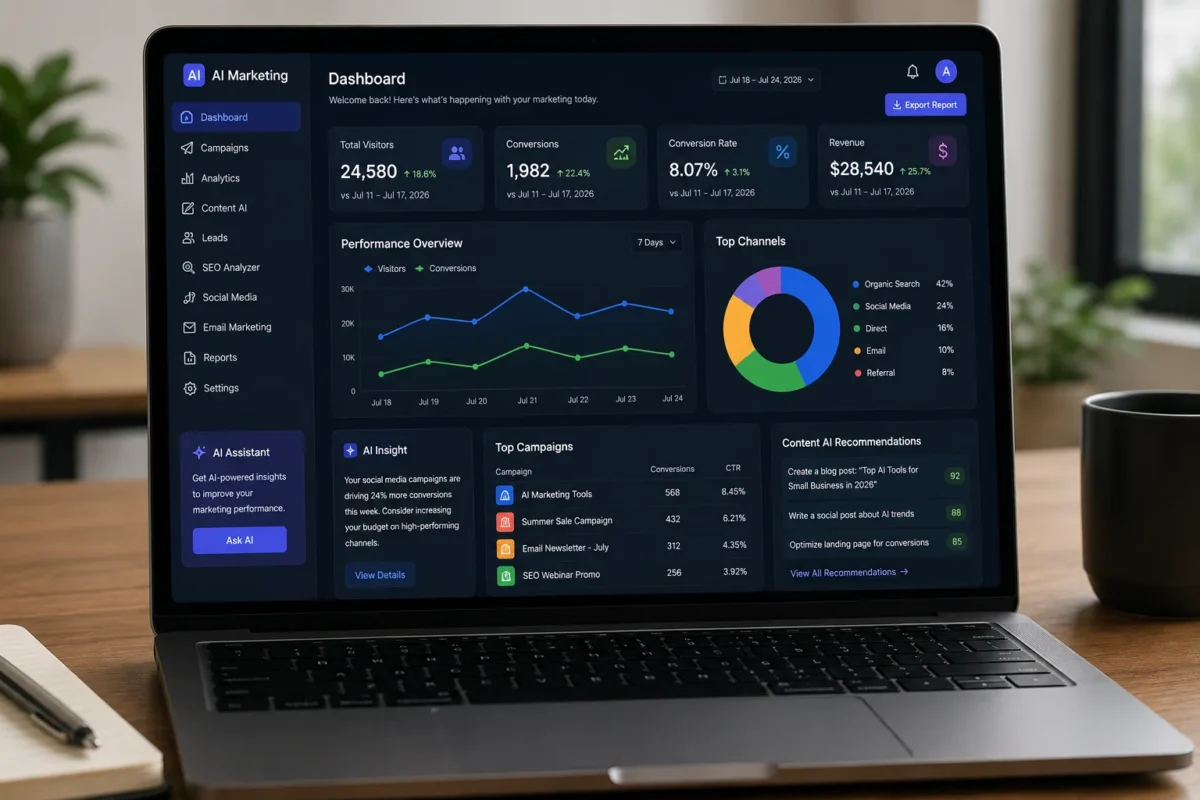
For example, imagine an online clothing store receives hundreds of visitors every day. AI analyses browsing behavior and identifies customers who repeatedly view the same products but never complete their purchase. The system automatically sends a personalized discount email, increasing the chances of conversion without requiring any manual intervention.
Search visibility is another area where AI provides enormous value. Platforms specializing in Search engine optimization recommend keywords, improve Content optimization, and identify missing topics based on competitor analysis. Instead of guessing what Google wants, businesses receive practical recommendations backed by real data.
AI also strengthens customer support. Tools offering Live chat and AI-powered customer support answer frequently asked questions around the clock. Customers receive immediate assistance while employees spend more time solving complex issues that require human expertise.
Administrative work becomes easier as well. Many business platforms automate Workflow automation, Business automation, Data automation, and repetitive office tasks. Instead of manually transferring information between applications, AI keeps everything synchronized automatically. This reduces errors while improving overall efficiency.
Financial management also benefits from intelligent automation. Accounting software now simplifies Invoicing, Bank reconciliation, and Financial reporting, giving business owners a clearer understanding of cash flow and company performance.
The table below summarizes the biggest advantages of using AI in marketing.
| Benefit | Business Impact |
| Time-saving software | Reduces repetitive daily work |
| Cost-saving software | Lowers outsourcing and staffing costs |
| Business efficiency | Improves productivity across departments |
| Research tool | Speeds up market and keyword research |
| Marketing campaigns | Optimizes campaign performance |
| Business operations | Simplifies everyday management |
| AI summaries | Quickly review reports and meetings |
| Competitor research | Discover new market opportunities |
| Industry trends | Stay updated with changing customer behavior |
Perhaps the greatest advantage is scalability. As your business grows, your workload increases. Instead of hiring multiple employees immediately, AI helps you manage larger marketing campaigns, serve more customers, and improve productivity without dramatically increasing operating costs. That is why businesses of every size are investing in AI—not because it replaces people, but because it helps people work smarter.
How to Choose the Right AI Marketing Tool?
Choosing from hundreds of AI Marketing Tools can feel overwhelming, especially if you are new to Artificial intelligence. Every platform promises to save time, increase sales, and improve marketing results. However, the best tool is not always the one with the most features. It is the one that solves your biggest business problem while fitting your budget and workflow.
Before you subscribe to any platform, identify your marketing goals. Ask yourself what takes the most time every week. Do you struggle to write blog posts, manage social media, send emails, or optimize your website for search engines? Once you know your biggest challenge, finding the right solution becomes much easier.
For example, if creating blog posts is slowing your business down, choose an AI writing assistant or an AI content generator like ChatGPT or Jasper. If you want to improve your website rankings, invest in software designed for AI for SEO. Businesses that rely heavily on customer communication may benefit more from an AI-powered CRM with built-in Customer relationship management features.
Budget is another important factor. Many excellent AI platforms offer free plans or free trials, making them perfect for startups and small businesses. Starting with a free version lets you explore the software before committing to a paid subscription. As your business grows, you can upgrade to unlock advanced automation, reporting, and collaboration features.
Ease of use should never be ignored. Some platforms are designed for experienced marketers, while others are built for beginners. A simple dashboard, clear navigation, and helpful tutorials reduce the learning curve and help your team start using the software immediately. The easier a tool is to understand, the faster you will see results.
Integration is equally important. Your AI software should work seamlessly with the applications you already use. Strong AI integrations connect your website, email platform, accounting software, CRM, and social media channels into one connected system. This creates an efficient AI workflow that eliminates duplicate work and improves accuracy.
Suppose your online store receives orders through Shopify, collects customer emails with Mailchimp, and tracks leads inside HubSpot. If your AI tools communicate with one another, customer information moves automatically between systems. This type of Business workflow automation saves valuable time while reducing manual errors.
Security is another area many business owners overlook. AI platforms often process customer information, payment records, and marketing data. Always choose software providers that offer strong security measures, regular updates, and transparent privacy policies. Protecting customer data builds trust and supports long-term business growth.
Scalability also matters. The software you choose today should continue supporting your business next year. Instead of replacing your marketing platform every time your business expands, invest in flexible solutions that can grow alongside your company. This approach saves money and reduces future migration challenges.
Customer support is another factor worth considering. Even the best software occasionally presents questions or technical issues. Responsive customer support, detailed documentation, and active user communities make learning much easier. Businesses often underestimate how valuable good support becomes during busy marketing campaigns.
The comparison table below highlights the most important factors to evaluate before selecting an AI marketing solution.
| Factor | Why It Matters |
| Business Goals | Ensures the tool solves your biggest marketing challenge. |
| Ease of Use | Helps your team learn the software quickly. |
| Pricing | Keeps costs within your budget. |
| Features | Provides the functions your business actually needs. |
| AI integrations | Connects existing business applications smoothly. |
| Security | Protects customer and business data. |
| Scalability | Supports future business growth. |
| Customer Support | Provides help whenever technical issues arise. |
Another helpful strategy is to compare several tools before making a final decision. Most software companies offer demonstrations or trial periods. Use this opportunity to test the interface, evaluate the features, and see how well the platform fits your daily workflow. A practical test often reveals strengths and weaknesses that product pages cannot show.
It is also important to think beyond features. A platform with hundreds of options may look impressive, but unnecessary complexity often slows teams down. Instead, choose software that simplifies your work rather than creating additional tasks. Simplicity usually delivers better long-term results than overwhelming functionality.
As your business expands, your marketing needs will change. You may begin with an AI design tool for creating graphics, then later add AI productivity software to organise projects, followed by AI sales tools to improve lead management. Building your technology stack gradually allows your team to adapt without becoming overwhelmed.
Remember that AI should support your expertise, not replace it. The best marketing campaigns still require creativity, strategic thinking, and genuine human connection. AI simply removes repetitive work so you can spend more time building relationships with customers and improving your products.
By selecting the right AI Marketing Tools, you create a strong foundation for sustainable growth. Instead of working harder every year, you work smarter through intelligent automation, better decision-making, and improved efficiency. That combination allows even the smallest businesses to compete confidently in today’s digital marketplace.
Best AI Marketing Tools for Small Businesses
Finding the right AI Marketing Tools can completely change how you run your business. Instead of spending hours writing content, designing graphics, scheduling social media posts, or following up with leads, AI helps you complete these tasks in minutes. The result is better Business efficiency, lower operating costs, and more time to focus on serving customers.
However, not every tool is built for the same purpose. Some excel at AI for content writing, while others specialize in AI for graphic design, AI for SEO, or AI for social media. The best approach is to choose tools that solve your biggest challenges instead of buying software with features you may never use.
The table below provides a quick overview of the best AI marketing tools for small businesses in 2026.
| AI Tool | Best For | Free Plan | Ideal For |
| ChatGPT | Content writing | Yes | Bloggers, marketers, startups |
| Canva Magic Studio | Graphic design | Yes | Social media and branding |
| Jasper AI | Marketing copy | Trial | Copywriters and agencies |
| Surfer SEO | SEO optimization | Trial | Bloggers and websites |
| Semrush AI Toolkit | Keyword research | Trial | SEO professionals |
| AdCreative.ai | Advertising | Trial | Paid advertising campaigns |
| Buffer | Social media | Yes | Content scheduling |
| Mailchimp | Email marketing | Yes | Email campaigns |
| HubSpot | CRM and automation | Yes | Sales and customer management |
| Grammarly | Writing improvement | Yes | Business communication |
| Pictory AI | Video creation | Trial | Video marketing |
| Notion AI | Productivity | Trial | Team collaboration |
ChatGPT – Best for Content Writing and Brainstorming
Creating fresh content every week is difficult for most small businesses. Blog posts, product descriptions, newsletters, and social media captions all require time and creativity. ChatGPT solves this problem by acting as an intelligent AI assistant that generates ideas, outlines, and first drafts within seconds.
One of ChatGPT’s biggest strengths is Content creation. Instead of staring at a blank screen, you simply describe your topic, and the platform creates structured content that you can edit and personalise. This makes it an excellent AI writing assistant for entrepreneurs who manage their own marketing.
For example, a real estate agency can use ChatGPT to write neighbourhood guides, property descriptions, email newsletters, and frequently asked questions without hiring a full-time writer.
Key Features
| Feature | Benefit |
| Blog writing | Creates article drafts quickly |
| Email generation | Produces personalised email campaigns |
| Content ideas | Eliminates writer’s block |
| Marketing copy | Writes advertisements and landing pages |
| Research support | Speeds up content planning |
Canva Magic Studio – Best for AI Graphic Design
Professional graphics help businesses stand out online, but hiring a designer for every project is expensive. Canva Magic Studio makes visual design simple through AI-powered design features that generate graphics from short text prompts.
Whether you need Instagram posts, Facebook advertisements, presentations, or marketing banners, Canva produces attractive visuals in minutes. Features like Magic Design, Magic Write, and automatic background removal save valuable time while maintaining a professional appearance.

A local restaurant, for example, can design promotional posters, menu updates, and social media graphics without any previous design experience.
Best For
- AI for graphic design
- Social media graphics
- Marketing materials
- Business presentations
- Brand consistency
Jasper AI – Best for Marketing Copy
Writing persuasive copy requires both creativity and strategy. Jasper AI focuses on helping businesses create advertisements, website copy, product descriptions, and promotional emails that encourage customers to take action.
Unlike general writing tools, Jasper is designed specifically for marketing. It supports multiple writing styles and helps maintain a consistent brand voice across different channels.
Businesses running regular Marketing campaigns often use Jasper to produce landing pages, Facebook ads, and sales emails much faster than writing everything manually.
Surfer SEO – Best for SEO Optimization
Publishing great content is only the first step. Customers still need to find your website through search engines. Surfer SEO improves Search engine optimization by analyzing top-ranking pages and providing practical recommendations for improving your content.
The platform assists with SEO optimization, Content optimization, keyword placement, heading structure, and readability. Instead of guessing what Google expects, you receive recommendations based on real search data.
Imagine writing an article about home insurance. Surfer compares your content against competing pages and suggests additional topics that could improve your ranking.
Why Businesses Love Surfer SEO
| Advantage | Result |
| Keyword recommendations | Better rankings |
| Content scoring | Easier optimization |
| Competitor analysis | Stronger articles |
| SEO auditing | Improved website performance |
Semrush AI Toolkit – Best for Keyword Research and Competitor Analysis
Understanding your competitors is essential for long-term growth. Semrush combines advanced keyword research with Competitor research, backlink analysis, traffic monitoring, and Business analytics.
Instead of guessing which keywords customers search for, Semrush identifies valuable opportunities based on search volume, competition, and user intent. This information helps businesses create stronger SEO strategies while avoiding highly competitive keywords.
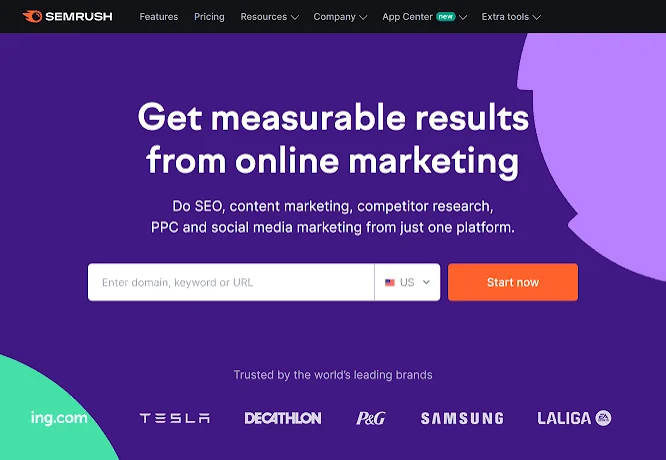
For companies focused on organic growth, Semrush is one of the most complete AI marketing software solutions available.
AdCreative.ai – Best for Advertising
Online advertising often requires multiple versions of banners, headlines, and images. Creating these assets manually takes time and creative effort. AdCreative.ai automates the process by generating advertisements that are designed to improve click-through rates.
The platform supports AI for advertising by analyzing previous campaign performance and suggesting high-converting creative designs. Businesses running Google Ads or Facebook Ads can quickly test different versions without hiring professional designers.
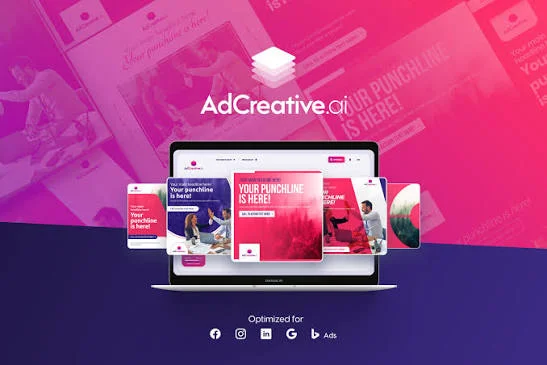
Small businesses with limited advertising budgets benefit because they can experiment with more campaigns while reducing design costs.
Buffer – Best for Social Media Management
Maintaining an active social media presence requires consistency. Buffer simplifies this process through scheduling, planning, and AI-assisted content creation.
Instead of posting manually every day, Buffer allows businesses to prepare content weeks in advance. It also rewrites captions for different social networks, making it an excellent solution for AI for social media.
For example, a fitness coach can publish one promotional message across Instagram, Facebook, LinkedIn, and X while Buffer automatically adjusts the formatting for each platform.
The software also functions as a reliable AI scheduling tool, helping businesses remain active online even during busy periods.
Mailchimp – Best for Email Marketing
Email remains one of the highest-performing digital marketing channels. Mailchimp combines automation with intelligent recommendations to improve Email marketing performance.
Its AI analyses subscriber behavior and recommends subject lines, sending times, and audience segmentation strategies that increase engagement. Businesses also benefit from personalized automation sequences that welcome new subscribers or recover abandoned shopping carts.
As an AI email assistant, Mailchimp saves time while improving customer communication and increasing conversions.
HubSpot – Best CRM and Marketing Automation
Strong customer relationships lead to repeat business. HubSpot combines Customer relationship management, CRM, sales tools, and Marketing automation into one easy-to-use platform.
Its AI automatically performs Lead scoring, tracks customer activity, and improves Pipeline management by identifying the most promising sales opportunities.
For example, if a visitor downloads several guides and repeatedly checks your pricing page, HubSpot recognizes this buying intent and recommends immediate follow-up.
Businesses looking for an all-in-one AI-powered CRM often choose HubSpot because it supports both marketing and sales teams.
Grammarly – Best AI Writing Assistant
Every email, proposal, and website page reflects your brand. Grammarly helps ensure your writing remains professional by checking grammar, spelling, clarity, and tone.
Beyond correcting mistakes, Grammarly acts as an AI writing assistant that improves sentence structure and readability. This makes it valuable for businesses communicating with customers every day.
Whether you are writing blog articles, client emails, or business proposals, Grammarly helps you present a polished image.
Pictory AI – Best for Video Marketing
Video continues to dominate online marketing, but producing high-quality videos often requires expensive editing software and technical expertise. Pictory AI changes this by converting articles, scripts, and blog posts into engaging videos automatically.
Businesses can repurpose existing content into YouTube videos, Facebook reels, or promotional clips using AI-powered content instead of creating everything from scratch.
For small businesses, this saves both time and production costs while expanding content across multiple platforms.
Notion AI – Best for Productivity and Planning
Successful marketing depends on organization. Notion AI combines project management, documentation, brainstorming, and collaboration into one workspace.
It improves Business productivity by creating meeting notes, project summaries, and task lists automatically. Features such as Meeting transcription and AI summaries reduce administrative work, allowing teams to focus on execution instead of paperwork.
For businesses managing several marketing projects at once, Notion AI becomes a valuable AI business assistant that keeps information organized and easily accessible.
These platforms demonstrate how AI Marketing Tools can support every stage of your marketing journey, from planning and content creation to customer engagement and performance tracking. Rather than replacing human creativity, they remove repetitive tasks so you can spend more time building your business.
Best Free AI Marketing Tools for Small Businesses
Many small business owners assume they need a large budget to start using AI. Fortunately, that is no longer true. Several leading AI Marketing Tools offer generous free plans that provide enough features to improve productivity, automate routine tasks, and support business growth. These free versions are ideal for startups, freelancers, and entrepreneurs who want to experience the benefits of Artificial intelligence before investing in premium software.
The biggest advantage of free AI tools is that they reduce financial risk. Instead of paying for software you may never use, you can test different platforms and discover which ones fit your workflow. As your business expands, upgrading to paid plans becomes much easier because you already understand how each platform works.
Below are some of the best free AI marketing tools available in 2026.
| Tool | Free Features | Best For |
| ChatGPT | Writing, brainstorming, research | AI for content writing |
| Canva | AI design features | AI for graphic design |
| Buffer | Social scheduling | AI for social media |
| Mailchimp | Email campaigns | AI for email campaigns |
| HubSpot | CRM tools | AI-powered CRM |
| Grammarly | Grammar and writing suggestions | AI writing assistant |
| Perplexity | AI-powered search | AI for research |
| Zapier | Limited automations | Business workflow automation |
ChatGPT remains one of the strongest free tools because it assists with blog posts, product descriptions, marketing ideas, and customer communication. Whether you need article outlines or fresh advertising concepts, it functions as a reliable AI content generator that saves hours every week.
Canva’s free plan is another excellent choice. Small businesses can create professional graphics, presentations, social media posts, and promotional materials without hiring a designer. Combined with its AI features, Canva becomes a practical AI design tool for businesses with limited budgets.
Buffer provides a simple way to schedule social media posts across multiple platforms. Instead of logging into every account individually, you prepare content once and let Buffer publish it automatically. This improves consistency while supporting AI for social media marketing.
Mailchimp continues to be one of the most trusted platforms for Email marketing. Its free plan allows businesses to create newsletters, manage subscribers, and send campaigns while benefiting from basic automation features.
HubSpot offers one of the most generous free CRM systems available. Businesses can organize contacts, monitor customer interactions, and improve Customer relationship management without paying monthly fees. As your customer base grows, additional automation features become available through paid plans.
Grammarly is another valuable addition to any marketing toolkit. Clear communication builds trust, and Grammarly helps improve blog posts, proposals, emails, and reports through intelligent writing suggestions. As an AI writing assistant, it helps businesses maintain a professional tone across all communication.
Perplexity has quickly become a favorite AI search engine for business research. Instead of displaying pages of search results, it provides direct answers with supporting sources. This makes competitor analysis, market research, and trend monitoring much faster.
Zapier deserves special attention because it focuses on Workflow automation. It connects thousands of applications, allowing businesses to automate repetitive tasks without writing code. Customer enquiries, email notifications, spreadsheet updates, and CRM activities can all work together automatically through Data automation.
Although free plans have limitations, they often provide enough functionality for small businesses during their early growth stages. As your marketing becomes more advanced, upgrading unlocks additional integrations, reporting tools, and automation features.
AI Marketing Tools by Category
Not every business has the same marketing priorities. An online clothing store may focus on email campaigns, while a local law firm may care more about SEO and lead generation. Understanding AI tools by category makes it easier to choose software that solves your specific challenges instead of paying for unnecessary features.
The table below highlights the best AI solutions based on marketing categories.
| Category | Recommended Tool |
| AI for content writing | ChatGPT, Jasper AI |
| AI for SEO | Surfer SEO, Semrush |
| AI for social media | Buffer |
| AI for email campaigns | Mailchimp |
| AI for graphic design | Canva Magic Studio |
| AI for advertising | AdCreative.ai |
| AI for customer support | HubSpot, Tidio |
| AI for accounting | Zoho Books |
| AI for bookkeeping | Zoho Books |
| AI for research | Perplexity |
| AI for meetings | Otter.ai |
Businesses that rely on content marketing should begin with ChatGPT and Surfer SEO. Together they simplify Content creation, keyword research, and Content optimization, making it easier to publish articles that perform well in search engines.
Companies that depend on social engagement should prioritise Buffer and Canva. These platforms combine scheduling with attractive graphics, allowing businesses to maintain a consistent online presence while reducing manual work.
Email remains one of the highest-converting marketing channels. Mailchimp helps businesses automate welcome emails, promotional offers, and customer follow-ups using intelligent segmentation. This makes it one of the strongest platforms for AI marketing software focused on customer communication.
Customer service is another important category. HubSpot and Tidio improve Customer service through Live chat, AI chatbot technology, and intelligent ticket management. Customers receive quicker responses while support teams spend more time handling complex enquiries.
Businesses looking to improve internal operations should also consider Zoho Books, Zapier, and Notion AI. These tools automate accounting, project management, documentation, and administrative work, improving Business operations across the organization.
Rather than choosing every available platform, focus on one category at a time. Solving your biggest challenge first produces better results than trying to automate every process simultaneously.
How to Build an AI Marketing Strategy for a Small Business?
Buying powerful software is only the beginning. Without a clear strategy, even the best AI Marketing Tools cannot deliver consistent results. A successful AI marketing strategy starts with clear objectives, careful planning, and continuous improvement.
The first step is identifying your business goals. Ask yourself what success looks like over the next twelve months. You may want more website traffic, higher online sales, stronger customer engagement, or increased brand awareness. Once your objectives are clear, selecting the right AI tools becomes much easier.
The second step involves understanding your audience. AI performs best when it has accurate information about your customers. Learn what problems they face, where they spend time online, and what type of content they prefer. These insights help create more effective Marketing strategy decisions and improve personalization.
Content planning should come next. Instead of creating random articles or social media posts, develop a monthly content calendar that supports your business goals. AI tools help generate blog ideas, write first drafts, suggest headlines, and improve SEO optimization before publication.
Automation is another essential part of every modern marketing strategy. Activities such as email sequences, customer follow-ups, appointment reminders, and social media publishing can all benefit from Business automation. Eliminating repetitive work allows you to spend more time building relationships and improving customer experiences.
For example, imagine you own an online furniture store. A customer downloads a buying guide from your website. Your AI system automatically adds the customer to your email list, sends a welcome message, recommends related products, and reminds your sales team to follow up a few days later. Everything happens automatically through AI workflow, creating a smooth customer journey.
Measuring results is equally important. AI platforms provide detailed Business analytics that reveal which campaigns generate traffic, leads, and sales. Instead of relying on assumptions, you make decisions based on real performance data.
The following framework provides a simple roadmap for building an effective AI marketing strategy.
| Step | Purpose |
| Set marketing goals | Define measurable objectives |
| Understand your audience | Create personalized campaigns |
| Select AI tools | Match software to business needs |
| Plan content | Publish consistently |
| Automate workflows | Improve efficiency |
| Monitor performance | Measure campaign success |
| Optimize regularly | Improve long-term results |
One mistake many businesses make is expecting AI to replace human creativity. In reality, AI works best as a partner. It handles repetitive work while business owners focus on strategy, customer relationships, and creative thinking.
As your company grows, continue reviewing your marketing strategy every few months. Customer behavior changes, new technologies appear, and competitors adjust their tactics. Businesses that regularly analyses results and refine their AI systems remain more competitive over time.
Ultimately, the goal is not simply to use AI. The goal is to build a smarter marketing system that saves time, improves customer experiences, and supports sustainable business growth. By combining the right AI Marketing Tools with a well-planned strategy, even small businesses can compete successfully with much larger organizations.
Common Mistakes to Avoid When Using AI Marketing Tools
Using AI Marketing Tools can improve productivity and increase business growth, but only when they are used correctly. Many small businesses expect instant success after installing AI software. In reality, the tools are only as effective as the strategy behind them. Understanding the most common mistakes helps you avoid wasted time, poor results, and unnecessary expenses.
One of the biggest mistakes is publishing AI-generated content without reviewing it. AI can produce impressive drafts in seconds, but it does not always understand your brand voice, customer expectations, or industry expertise. Every article, email, and advertisement should be edited before publishing. Adding personal insights, examples, and real experiences makes your content more trustworthy and engaging.
Another common mistake is relying too heavily on automation. While Marketing automation saves time, customers still value genuine human interaction. Automated emails, chatbots, and scheduled posts should support your marketing rather than replace personal communication. If every customer interaction feels robotic, trust and engagement may decline.
Many businesses also purchase too many tools at once. New software launches almost every week, making it tempting to subscribe to multiple platforms. However, managing too many applications often creates confusion and increases costs. It is better to master one or two tools before expanding your AI toolkit.
Ignoring SEO optimization is another costly error. Some business owners assume AI-written content will automatically rank on Google. Unfortunately, search engines reward valuable, well-structured content rather than text generated without strategy. Every article should include proper keyword research, clear headings, internal links, and useful information. Combining AI with strong Search engine optimization practices produces much better results.
Poor AI integrations can also reduce productivity. If your CRM, email software, and website operate independently, employees waste time entering the same information repeatedly. Connecting your applications creates a seamless AI workflow that improves Data automation and reduces manual work.
Data privacy is another area that deserves attention. AI platforms often process customer information, business documents, and financial records. Choosing trusted software providers with strong security policies helps protect sensitive information and maintain customer confidence.
Finally, many businesses fail to monitor performance. AI provides valuable reports, but those insights are useless if nobody reviews them. Regularly analysing Business analytics allows you to identify successful campaigns, improve weak areas, and make smarter marketing decisions.
The table below summarizes the most common mistakes and their solutions.
| Common Mistake | Better Approach |
| Publishing AI content without editing | Review and personalize every piece of content |
| Buying too many AI tools | Start with one or two essential platforms |
| Ignoring SEO | Optimize every page before publishing |
| Overusing automation | Balance AI with human interaction |
| Poor software integration | Use connected applications with AI integrations |
| Ignoring performance reports | Monitor results using Business analytics |
| Weak security practices | Choose trusted providers with strong data protection |
Businesses that treat AI as a helpful assistant rather than a complete replacement for human expertise usually achieve the strongest long-term success.
AI Marketing Tools Comparison Table
Choosing the right AI Marketing Tools becomes much easier when you compare features side by side. Every business has different priorities, so selecting software based on your specific needs delivers better results than simply choosing the most popular platform.
The comparison below highlights some of the best AI marketing solutions available for small businesses.
| Tool | Best For | Free Plan | Ease of Use | Ideal Business |
| ChatGPT | Content creation | Yes | Excellent | Bloggers, agencies, startups |
| Canva Magic Studio | AI-powered design | Yes | Excellent | Retail, restaurants, freelancers |
| Jasper AI | Marketing copy | Trial | Very Good | Marketing agencies |
| Surfer SEO | Content optimization | Trial | Very Good | Websites and blogs |
| Semrush AI Toolkit | Competitor research | Trial | Good | SEO professionals |
| AdCreative.ai | Paid advertising | Trial | Very Good | E-commerce stores |
| Buffer | Social media marketing | Yes | Excellent | Small businesses |
| Mailchimp | Email marketing | Yes | Excellent | Online businesses |
| HubSpot | Customer relationship management | Yes | Very Good | Sales teams |
| Grammarly | Writing improvement | Yes | Excellent | Every business |
| Pictory AI | Video marketing | Trial | Good | Content creators |
| Notion AI | Business productivity | Trial | Excellent | Growing teams |
When comparing AI software, do not focus only on price. Consider ease of use, customer support, available integrations, scalability, and long-term value. A platform that saves several hours every week often delivers a much higher return than a cheaper solution with limited functionality.
Testing free plans is also a smart approach. Most businesses discover which software fits their workflow after using it for a few weeks rather than reading feature lists.
Future Trends in AI Marketing for Small Businesses
The future of AI Marketing Tools looks incredibly promising. Every year, AI becomes faster, more accurate, and easier to use. Businesses that adopt these technologies early often gain a competitive advantage because they can respond to customer needs more quickly and make smarter decisions.
One major trend is hyper-personalization. Instead of sending the same message to every customer, AI analyses behavior, purchase history, and preferences to deliver highly personalized recommendations. This improves AI customer engagement while increasing customer satisfaction and conversion rates.
Another important development is advanced AI-powered analytics. Future marketing platforms will predict customer behavior before it happens. Businesses will know which products customers are likely to buy, which campaigns need improvement, and when demand is expected to increase.
Voice search and visual search will also continue growing. More consumers now search using voice assistants and smartphone cameras instead of typing traditional keywords. Businesses should optimize their websites and content to remain visible across these emerging search methods.
Video marketing will become even more accessible through AI-powered content generation. Businesses will create professional videos, advertisements, and product demonstrations without needing expensive production equipment or advanced editing skills.
Automation will also become more intelligent. Instead of automating individual tasks, businesses will automate complete customer journeys. From the first website visit to the final purchase, AI will manage communication through connected Business workflow automation systems.
Another trend is the growth of AI business platforms that combine multiple marketing functions into one dashboard. Rather than managing separate tools for SEO, email, CRM, and social media, businesses will increasingly use integrated platforms that simplify operations and improve collaboration.
Although AI technology will continue advancing, one thing will remain unchanged. Customers still value honesty, trust, and genuine relationships. Businesses that combine AI efficiency with authentic human communication will continue building stronger brands than those relying entirely on automation.
Final Thoughts
Modern businesses face increasing competition, changing customer expectations, and limited resources. Fortunately, AI Marketing Tools allow even the smallest companies to compete more effectively by automating routine work and improving decision-making.
Whether your goal is Content creation, Digital marketing, Email marketing, SEO optimization, or Business automation, there is an AI solution designed to simplify the process. Instead of spending hours completing repetitive tasks, you can focus on strategy, creativity, and building stronger customer relationships.
The Best AI Marketing Tools for Small Business are not necessarily the most expensive platforms. The right choice is the software that solves your biggest challenges, fits your budget, and grows alongside your business. Starting with free plans is often the smartest approach because it allows you to gain experience before making larger investments.
As AI technology continues evolving, businesses that embrace innovation while maintaining a human touch will remain ahead of the competition. AI should enhance your expertise rather than replace it. When combined with thoughtful planning, consistent optimization, and genuine customer care, these tools become a powerful foundation for long-term business success in 2026 and beyond.
Frequently Asked Questions About AI Marketing Tools
Which AI tool is best for small business?
There is no single best tool for every business. ChatGPT is excellent for content creation, Canva for design, HubSpot for CRM, and Mailchimp for email marketing.
What are the 5 main AI tools?
The five popular AI tools for businesses are ChatGPT, Canva Magic Studio, HubSpot, Mailchimp, and Surfer SEO, covering content, design, CRM, email, and SEO.
How to use AI in your business in 2026?
Use AI to automate repetitive tasks, create marketing content, improve customer support, analyse business data, and optimise marketing campaigns to save time and increase efficiency.
How to use AI tools for marketing?
Use AI tools to create blog posts, schedule social media, run email campaigns, optimise SEO, generate ads, and track marketing performance with real-time analytics.
What should you avoid when using AI tools?
Avoid publishing AI-generated content without editing, relying completely on automation, ignoring data privacy, and using too many AI tools without a clear marketing strategy.